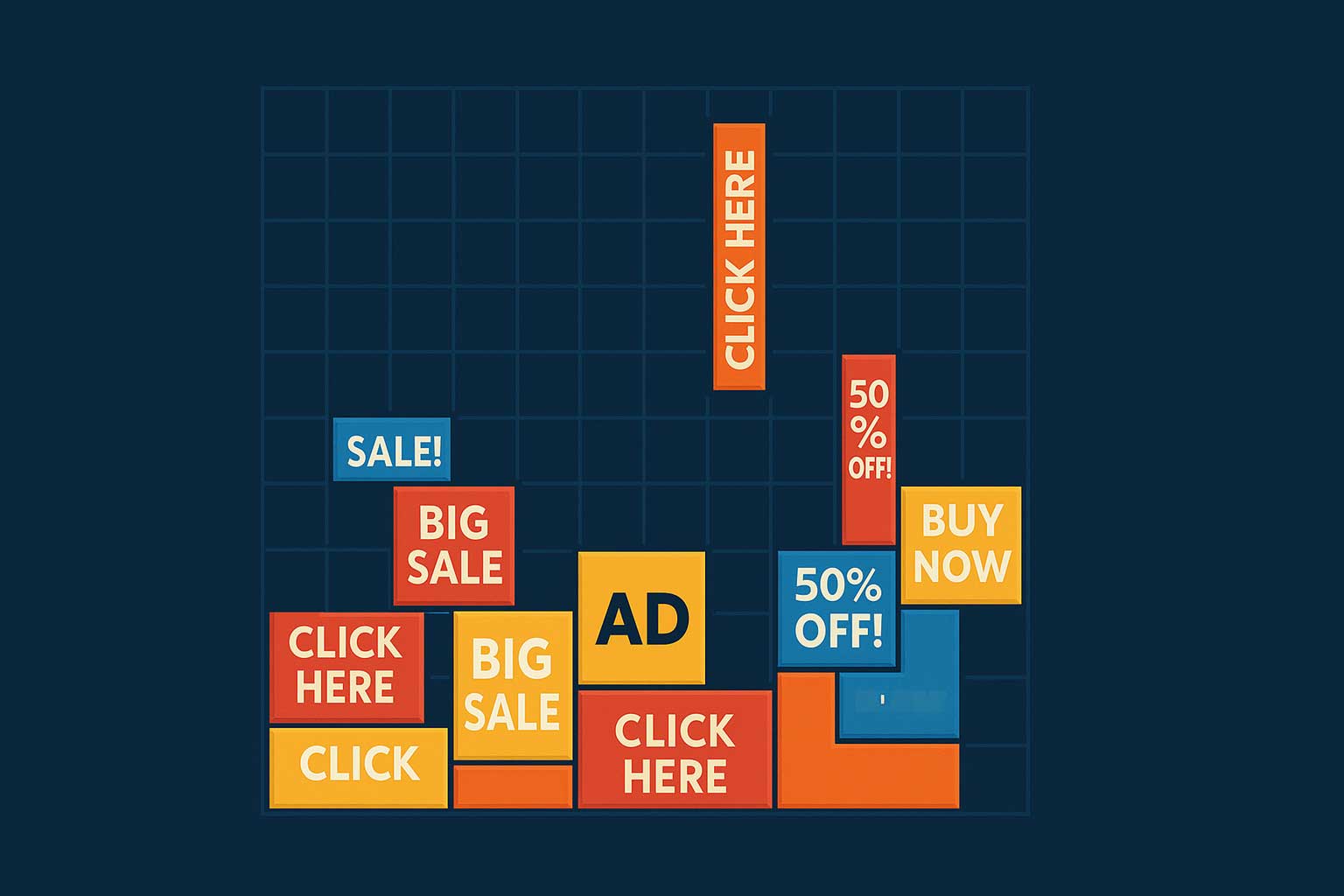
What is Banner Blindness and Banner Noise?
There banner blindness It is a psychological phenomenon that leads users to ignore online advertising banners. This behavior arises from’selective attention: the human brain, overloaded with visual stimuli, automatically filters out what it perceives as irrelevant or invasive to preserve limited cognitive resources.
The banner noise, instead, indicates the excessive amount of advertising messages Present simultaneously on a web page, generating visual confusion and saturation. This overabundance contributes to banner blindness, drastically reducing their effectiveness.
The impact on campaigns is significant: as banner ads decline in attention, performance declines, with click-through and conversion rates plummeting. Understanding how to combat AD blindness and banner noise is therefore crucial to capturing users' real attention and achieving tangible results in digital strategies.
Index
- The Role of Cognitive Psychology and Neuromarketing
- 3 Effective Strategies to Combat Banner Blindness and Banner Noise
- Best Practices for Maintaining High Advertising Performance
- Conclusions
The Role of Cognitive Psychology and Neuromarketing in the Fight Against Banner Blindness
The neuromarketing helps us understand how users interact with digital advertisements. One of the most effective techniques is’eye tracking, which analyses eye movements and’visual attention to the elements of a web page.
This technology is also based on the Gestalt psychology, which studies how the brain organizes visual stimuli. If a banner doesn't fit in with its context or is too discordant, users tend to ignore it, increasing banner blindness.
The relationship between memory, visual attention, and ad perception is crucial: an ad must immediately capture attention and leave a positive impression in the visual memory To be effective. Without adequate visual stimulation, the message risks being ignored or forgotten, compromising results.
3 Effective Strategies to Combat Banner Blindness and Banner Noise
1. Constantly refresh your creativity
Continuously updating advertising creative is one of the most effective strategies for combating banner blindness and banner noise. When a user is repeatedly exposed to the same banner, the brain tends to automatically ignore it, perceiving it as a familiar and unfamiliar signal. This reaction is at the root of the phenomenon of banner blindness.
To keep users' attention high, It's essential to periodically refresh the visual and textual elements of your ad. Creative refreshment doesn't just mean changing the image or color, but adopting a strategic approach that involves:
- Text message changes: Vary the slogan or call to action to stimulate new curiosities or respond to different audience needs.
- Color Update: Choosing different color palettes can influence the emotional perception of the ad and capture visual attention more effectively.
- Layout re-adaptation: Rearranging graphic elements can break up monotony and encourage a fresh reading of the ad, preventing it from being discarded outright.
This strategy requires constant monitoring of ad performance: a decline in click-through rates or engagement indicates that the novelty effect is wearing off. Prompt intervention with a creative refresh helps maintain curiosity and increase the communication's impact.
2. Leverage Diversified Advertising Formats
The use of dynamic formats such as carousel ads or collections, it allows you to significantly increase interactivity and user engagement, essential elements for capturing attention in a saturated digital context.
The main advantages of these formats include:
- More narrative space: The carousel allows you to display multiple products or messages in the same ad, stimulating curiosity and inviting discovery.
- Active interaction: the user is prompted to scroll or click, transforming the ad from a simple passive element into an engaging experience.
- Adaptability: Collections allow you to harmoniously combine images, videos, and text, offering a richer and more immersive presentation.
Adapting creatives to audience preferences becomes crucial. Static images can be turned into videos to attract those who prefer dynamic visual content, while effective videos can be converted into static images for those who prefer a faster and less invasive experience.
The diversification of formats not only stimulates new interest but It also reduces the risk of visual saturation, maintaining the high performance of advertising campaigns over time.
3. Strategic Use of User Generated Content (UGC) in Ads
The User Generated Content (UGC) It represents one of the most effective strategies for combating banner blindness and banner noise, thanks to its ability to appear native and authentic. When an ad uses content created directly by users, such as reviews, video testimonials, or candid photos, it generates a form of social proof which increases public trust and interest.
UGC is distinguished by:
- Authenticity: shows real experiences of ordinary people, making the advertising message less artificial.
- Emotional involvement: Users identify more easily with content created by other consumers than with brand content.
- Reduction of cognitive endurance: UGC content integrates naturally into the information flow, avoiding the “ignorant screen” effect of traditional banners.
Integrating UGC into advertising campaigns allows for constant creative refreshment, modifying the advertising message with ever-new and authentic materials. This strategy effectively combats AD Blindness and banner noise., attracting attention in a natural and engaging way.
Do you want to stand out and get noticed by users?
Contact us to improve your ad performance!
Best Practices for Maintaining High Advertising Performance Over Time
For generate scalable creativity To be effective, it's essential to design advertising content that flexibly adapts to the most popular digital channels, such as Facebook, Instagram, TikTok, and YouTube. Each platform requires a specific approach in terms of format and style, but maintaining visual and communicative consistency helps strengthen your brand and facilitate audience recognition.
1. Multi-channel adaptability
Create multiple versions of the same ad to optimize performance across vertical (TikTok, Instagram Stories), horizontal (YouTube), or square (Facebook Feed) formats.
2. Modular contents
Use separable graphic and text elements to create custom variations without having to rebuild the entire ad.
Theimportance of continuous variation It extends beyond simple graphic design. Regularly changing your ad format—from static images to short videos, interactive carousels, or collections—allows you to:
- increase coverage while avoiding audience saturation,
- stimulate different ways of enjoying and engaging,
- intercept different preferences within the same target.
This dynamic strategy effectively counteracts the cognitive saturation typical of banner blindness, maintaining user attention and improving overall campaign performance.
Conclusions
The creation of effective advertising campaigns It requires an approach that integrates cognitive psychology with the most advanced digital techniques. Understanding the mechanisms underlying banner blindness and banner noise allows us to develop targeted strategies to capture and maintain user attention.
Contact experts – like those at BigFive – in High performance advertising can make the difference in the success of your campaigns, optimizing your budget with a media planning targeted and bringing concrete results.
How to stand out amidst banner noise?
Contact BigFive to find the best solutions to promote your business!


